LEADERSHIP DEVELOPMENT: ORGANISATIONS
The Physiology of Leadership Performance
Developing leadership capability is one thing. Being able to use it under pressure is another.
Organisations invest considerable time and money in developing their leaders. Yet even highly capable people can struggle to apply those skills when they're exhausted, under sustained pressure or simply running out of energy.
Sleep, nutrition, stress and recovery influence the conditions in which leaders think, make decisions and interact with others. Yet the physiological dimension has traditionally received relatively little attention in leadership development.
The Physiology of Leadership Performance brings that missing dimension into the picture.
I work with organisations to explore how physiology influences leadership effectiveness, and how this understanding can be applied in practice — through tailored content integrated into existing leadership development programmes, or a dedicated, interactive Performance Lab.
Where the idea came from

During more than 30 years working in professional services, including as a Managing Director at Deloitte, I experienced first-hand the pressures of demanding leadership roles, as well as the challenges of developing other leaders.
I've seen organisations invest heavily in leadership development, yet also seen how difficult it can be for leaders to put those carefully developed skills into practice when they are exhausted, under pressure or simply running out of energy.
What interested me was that gap between having the capability and being able to use it when it really mattered.
When I subsequently studied nutritional therapy and human physiology, I began to understand more about the biological factors that can influence how we think, make decisions and respond to pressure.
The Physiology of Leadership Performance grew from bringing those two perspectives together.
Leadership performance is influenced not only by what leaders know and can do, but also by the physiological state in which they're operating.
My framework connects three interacting biological domains — circadian timing, fuel supply and physiological load — with the cognitive and emotional capabilities that underpin effective leadership.
The Leadership Physiology Framework
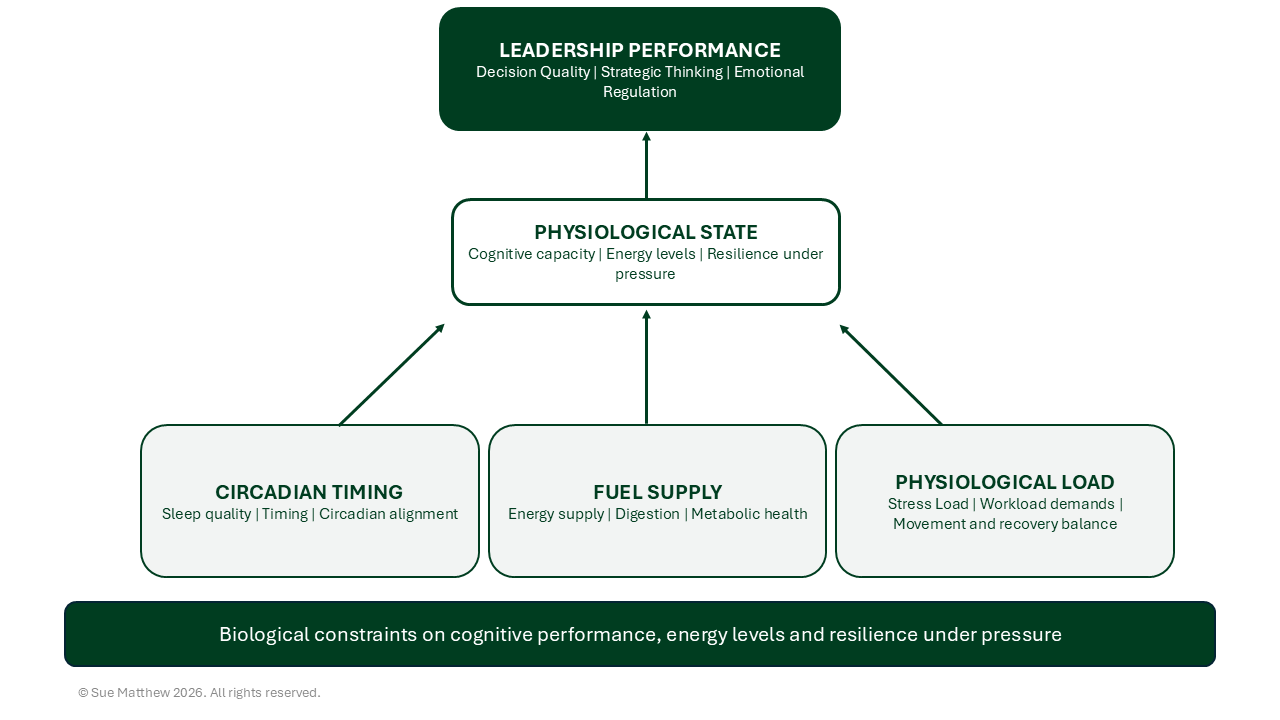
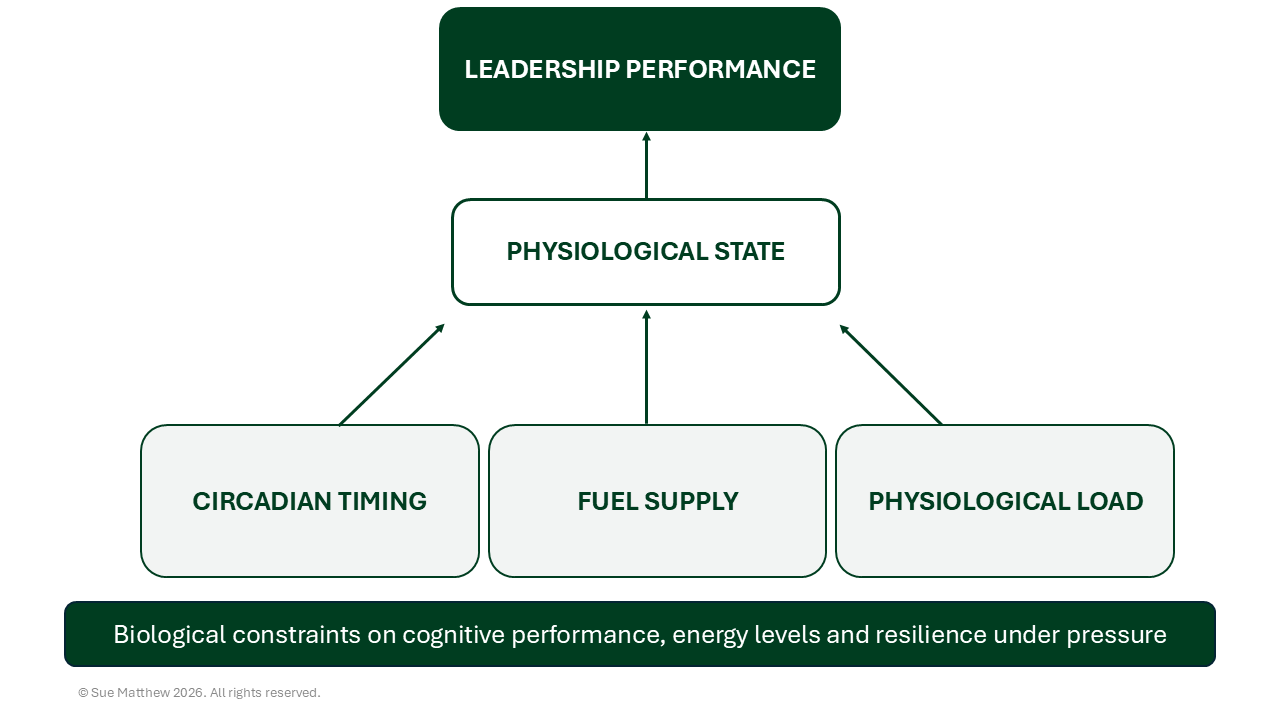
Irregular meals, reliance on caffeine, disrupted sleep, sustained pressure and limited recovery can interact in ways that gradually affect how leaders think, make decisions and respond to others. The framework helps us recognise those connections, understand how unhelpful patterns can reinforce one another, and identify where practical changes might make a difference.
Working with organisations
The Physiology of Leadership Performance can be tailored to your organisation's priorities, leadership population and existing development activities. The core framework and practical tools provide a consistent foundation, while content and delivery can be adapted to meet your needs.
Integrated Leadership Development

Strengthening the programmes you’re delivering.
Bringing the framework into existing leadership programmes, with tailored modules and tools that integrate the physiological dimension into leadership decision-making, resilience and performance under pressure.
Flexible integration: Content and delivery designed around your organisation's leadership priorities and existing programmes.
Performance Lab

An interactive exploration of leadership under pressure.
Applying the framework, and using tools to identify physiological constraints, examine real leadership decisions and develop more sustainable ways of working.
Flexible delivery: Hybrid format, tailored to organisational needs, with a fully virtual option to explore.
What does this look like in practice?
The value of understanding physiology comes from applying it to real leadership situations. Here are three examples of how the framework and tools can help leaders look at familiar challenges from a different perspective.
-
A leader has spent time developing their listening skills, emotional intelligence and ability to handle challenging conversations. But after a day of back-to-back meetings, little food and mounting pressure, they find themselves becoming impatient and reactive.
The skills haven't disappeared. But fatigue, hunger and stress may be making them harder to apply.
Using a Leadership Decision Post-Mortem, participants can revisit situations like this and explore how their physiological state may have influenced their behaviour. What could they recognise earlier, or do differently, to help them handle similar conversations more effectively?
-
A senior leader regularly skips meals, relies on caffeine, works late and travels frequently. Sleep and recovery suffer, and maintaining the same level of performance seems to require increasing effort.
Using Constraint Mapping and Reinforcing Loop Analysis, participants explore how working patterns, nutrition, sleep and physiological load may be interacting and reinforcing one another.
The aim is to identify practical leverage points — including aspects of the working environment — that could interrupt the cycle and support more sustainable performance, rather than simply asking people to cope with more pressure.
-
A leader has the knowledge and experience needed for an important negotiation. But the days leading up to it are filled with travel, competing deadlines and disrupted sleep.
A Leadership Decision Pre-Mortem adds another dimension to their preparation. Alongside the usual commercial and strategic considerations, they examine their cognitive readiness, recovery, energy and the physiological pressures surrounding the event.
This helps them identify practical adjustments to the conditions in which they'll need to exercise their judgement — before the pressure moment arrives.
Let’s talk about your organisation
Whether you're looking to strengthen an existing leadership development programme, explore a dedicated Performance Lab or consider how The Physiology of Leadership Performance could help address your organisation's challenges, I'd love to hear from you.
Arrange a conversation or get in touch by email to discuss your organisation’s priorities and explore what might work for your leaders.